Polymarket Lawsuit Turns a Bitcoin Market Dispute Into a Test of Prediction-Market Trust
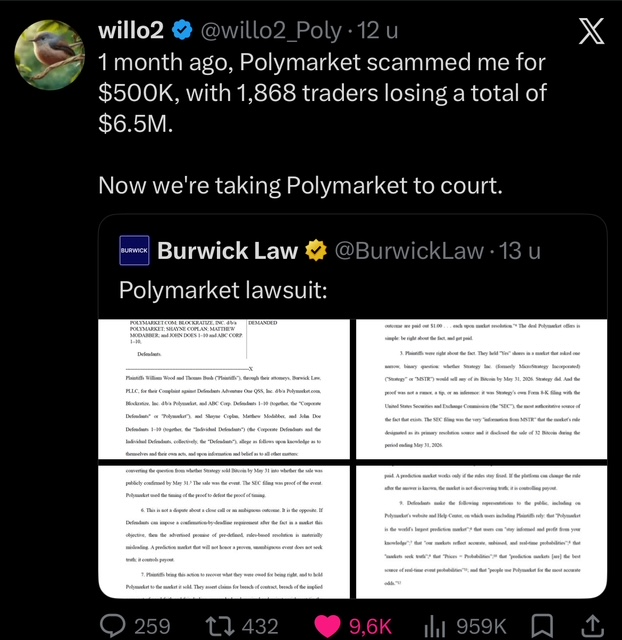
Polymarket sells a simple promise: be right about the world, and get paid. A new lawsuit in New York now challenges that promise at its core.
According to a complaint filed in New York County Supreme Court on July 3, two plaintiffs, William Wood and Thomas Bush, accuse Polymarket and related defendants of refusing to pay traders who bought “Yes” shares in a market asking whether Strategy Inc., formerly MicroStrategy, would sell any Bitcoin by May 31, 2026. The plaintiffs say Strategy did sell Bitcoin during the relevant period, and that the proof came from Strategy’s own filing with the US Securities and Exchange Commission.
Polymarket, they allege, resolved the market as “No”.
The dispute may sound narrow. It is not.
At stake is a larger question about prediction markets: whether they are neutral mechanisms for pricing real-world truth, or platforms whose control over rules, clarifications and resolution architecture can determine who gets paid.
For a sector trying to present itself as financial infrastructure rather than gambling, that distinction is critical.
What is Polymarket
Polymarket is a decentralized prediction-market platform that lets users trade shares on the outcome of real-world events. Launched in 2020, it covers topics ranging from politics and sports to cryptocurrency and corporate decisions. Users buy and sell shares tied to yes-or-no questions, with prices reflecting the market’s collective estimate of probability. The platform uses blockchain-based settlement and often relies on third-party oracles to resolve markets, positioning itself as a source of real-time, crowdsourced forecasts rather than a traditional gambling site.
The market at the centre of the dispute
The disputed Polymarket contract asked whether Strategy would sell any Bitcoin by May 31, 2026.
For traders, the premise was clear. If Strategy sold Bitcoin by the deadline, “Yes” should win. If it did not, “No” should win.
The plaintiffs allege that Strategy did sell 32 Bitcoin during the period ending May 31, 2026, and that the company later disclosed the sale in a Form 8-K filing. Their argument is that the relevant event was the sale itself, not the later timing of public confirmation.
Polymarket’s position, according to reporting at the time, was that the market should resolve “No” because the sale was not publicly confirmed by the market deadline. Crypto industry coverage described the controversy as a dispute over whether execution or disclosure should determine the outcome. CoinDesk reported in June that the Strategy sale sparked a large prediction-market dispute after Strategy’s first disclosed Bitcoin sale raised questions over whether trades executed between May 26 and May 31 counted toward the May 31 deadline.
That difference matters.
If the event was “Strategy sells Bitcoin by May 31,” then the plaintiffs say the outcome was “Yes”. If the operative question became “Strategy publicly confirms by May 31 that it sold Bitcoin,” then “No” could be defended.
The lawsuit’s allegation is that Polymarket changed the practical meaning of the market after the fact.
“The sale was the event. The filing was proof.”
The most powerful line in the complaint is also the simplest.
The plaintiffs argue that “the sale was the event” and that the SEC filing was proof of the event. They say Polymarket used the timing of the proof to defeat the proof of timing.
That framing is important because it turns the dispute from a technical settlement fight into a consumer-trust issue.
Prediction markets rely on rules. A user must believe that the wording of a market means what it says, that the rules will not change after trading closes, and that the final resolution will reward the side that correctly predicted the real-world outcome.
If that confidence breaks, the product changes.
A prediction market no longer prices truth. It prices platform discretion.
That is the core allegation in the complaint.
Prediction markets and the promise of truth
Polymarket’s appeal is built on the idea that markets can aggregate information better than pundits, polls or commentary.
Users buy and sell shares tied to real-world outcomes. Prices are treated as probabilities. A share that trades at 65 cents implies the market assigns roughly a 65 per cent chance to that event, ignoring fees, liquidity and other market frictions.
This is the intellectual case for prediction markets. They are supposed to reward research, judgement and informed risk-taking.
The complaint leans heavily on that promise. It says Polymarket presents itself as a platform where users can profit from knowledge, where markets reflect accurate and real-time probabilities, and where the correct final outcome is paid.
That language matters because the plaintiffs are not only claiming they lost a bet. They are alleging that they bought into a product representation.
In their view, the product was not simply the market. The product was rules-based resolution.
A lawsuit about control
Polymarket often emphasizes decentralization, prediction-market mechanics and third-party resolution processes. The complaint attempts to cut through that framing.
The plaintiffs allege that users experience Polymarket as one integrated platform: one brand, one market page, one trading interface, one set of rules and one public promise. They argue that the defendants controlled the market page, the rules, the clarification language, the trading interface, the order book and the payout.
The complaint specifically argues that saying markets are resolved by the UMA Optimistic Oracle does not remove responsibility from Polymarket. In the plaintiffs’ telling, the oracle responds to the rules and clarifications supplied to it. It does not write the market.
That distinction is central.
A platform cannot, the plaintiffs argue, outsource responsibility for a rule it wrote and a clarification it posted to a process it framed.
This is likely to become one of the most important issues in the case. If a prediction market platform is seen as merely providing infrastructure, its liability picture looks different. If it is seen as the controlling party that defines markets, frames clarifications and influences resolutions, then the consumer-protection implications are larger.
Why the case matters beyond one Bitcoin market
Prediction markets are trying to enter the mainstream.
They are no longer niche crypto experiments used only by political obsessives and blockchain traders. They now sit at the edge of finance, gambling, media and sports betting. The category includes platforms that argue they should be treated as federally regulated event-contract markets, not state-regulated sportsbooks.
That argument depends on credibility.
If prediction markets are to be treated more like financial exchanges than casinos, users must believe that contract terms are stable and outcomes are objectively resolved. A sportsbook can void or settle markets according to its house rules, but a prediction market claims something different. It claims to discover and price truth.
This lawsuit therefore strikes at the sector’s preferred identity.
It asks whether prediction markets are really neutral information markets, or whether users are exposed to discretionary platform risk that looks more like gambling-site risk.
The regulatory backdrop
Polymarket has already faced regulatory pressure.
In January 2022, the US Commodity Futures Trading Commission ordered Blockratize Inc., doing business as Polymarket, to pay a $1.4mn civil monetary penalty for offering off-exchange event-based binary options contracts and failing to obtain designation as a contract market or registration as a swap execution facility. The CFTC order also required Polymarket to wind down non-compliant markets.
Canada has also examined Polymarket through a securities-law lens. In 2025, the Ontario Securities Commission said Blockratize Inc. and Adventure One QSS Inc. violated Ontario securities law by offering binary options to Ontario investors through Polymarket in breach of the province’s binary options ban.
Those actions show why the Strategy Bitcoin dispute is not happening in isolation.
Prediction markets sit in a contested regulatory space. Depending on the jurisdiction and product, they may be described as event contracts, binary options, swaps, gambling products or securities-like instruments. The label matters because it determines who regulates the product, what disclosures are required, what consumer protections apply and how disputes are handled.
The Polymarket lawsuit adds another layer: even if the product is legal, how much discretion should the platform have over the meaning of a market?
The marketing problem
The lawsuit screenshots also point to a second reputational issue: marketing.
The complaint names Matthew Modabber, described in the filing as Polymarket’s chief marketing officer, and alleges that Polymarket’s marketing included campaigns promoting fake winnings and paying creators without proper disclosure. Those allegations are separate from the Strategy Bitcoin market dispute, but they sit inside the same broader trust problem.
Polymarket has already faced public scrutiny over influencer marketing. The Wall Street Journal reported that viral Polymarket videos showed people appearing to win big, but that the bets were not real; Ars Technica summarized the investigation as finding that winning bets were shown on a cloned website and would have lost money on the real platform.
For a platform whose brand is accuracy, market integrity and truth, that is dangerous territory.
A prediction market can survive users losing money. It cannot easily survive users believing that the platform’s rules, marketing and resolutions are all more flexible than advertised.
Why this is relevant to gambling markets
The Polymarket case also matters for the gambling industry.
Traditional gambling operators are regulated around consumer protection, advertising, age verification, responsible gambling, dispute handling and market integrity. Prediction markets often argue that they are different: they are information markets, not gambling products.
But for many users, the experience can feel similar.
They risk money on uncertain outcomes. They trade on sports, politics, crypto prices, corporate events and cultural moments. They can win or lose quickly. They may rely on platform rules that they do not fully understand. They may be influenced by social media, content creators and viral claims about easy profits.
That overlap is why regulators in several jurisdictions have taken interest in prediction markets.
In Australia, the Australian Communications and Media Authority issued a formal warning to Adventure One QSS Inc., the operator of Polymarket, over its services. In Nevada, regulators have also pursued prediction-market operators as part of a broader fight over whether event contracts should be treated as gambling products or federally regulated derivatives.
The Strategy Bitcoin lawsuit does not answer that regulatory question. But it sharpens it.
If market participants believe they are trading on objective, rules-based outcomes, then retroactive ambiguity becomes a consumer-protection issue. If users are effectively betting on how a platform will interpret its own language, then the product looks less like a truth market and more like a game controlled by the house.
The problem with “clarification”
Clarification is useful when a market is genuinely ambiguous.
But after-the-fact clarification is dangerous.
The complaint alleges that Polymarket posted new clarifying language after the fact, converting the question from whether Strategy sold Bitcoin by May 31 into whether that sale was publicly confirmed by May 31. That is the hinge of the dispute.
Prediction markets need mechanisms for ambiguous events. Markets can be poorly worded. Real-world outcomes can be messy. Data sources can conflict. A platform needs a way to handle edge cases.
But the more discretion a platform has to clarify rules after trading, the more traders must price that discretion as a risk.
That weakens the product.
The point of a prediction market is not merely that somebody resolves the market. It is that participants can understand the resolution logic before they trade.
What Polymarket will likely argue
Polymarket has not had its defence tested in this case.
Based on the public dispute, the platform is likely to argue that market resolution depended on the market’s rules and available confirmation sources by the deadline. It may argue that the June 1 filing came too late for a May 31 deadline, even if the underlying sale took place earlier. It may also argue that traders knew or should have known the market depended on public confirmation within the relevant period.
That defence would turn the case back toward contract interpretation.
Was the market asking whether the event happened, or whether it was verifiably confirmed by a certain time? Did the market rules clearly say one thing? Were later clarifications consistent with the original rules? Did the plaintiffs assume a reading that the terms did not support?
Those are legal questions for the court, not conclusions for readers.
But the fact that such questions arise at all is the commercial problem for prediction markets. If a market with a simple binary question can become a dispute over event timing, evidence timing and clarification timing, then the promise of simplicity begins to erode.
Canada should watch closely
For Canadian gambling and financial regulators, the case is worth watching.
Canada already has a complicated relationship with prediction markets. Ontario has treated Polymarket’s short-term binary options as a violation of the province’s binary options ban. At the same time, Canadian consumers can still encounter international prediction-market content, crypto platforms and social media promotion.
The Canadian online gambling market is becoming more sophisticated. Ontario has a regulated iGaming regime. Alberta is preparing its own competitive model. Sports betting is mainstream. Crypto gambling and prediction markets continue to blur borders.
The Polymarket dispute shows why product labels are not enough.
Whether a platform calls itself a prediction market, an event-contract exchange, a crypto trading venue or a gambling product, the same consumer questions remain: Are the rules clear? Are the outcomes objective? Can the operator change the meaning after trading? Are promotional claims fair? Can users challenge a resolution? Who regulates the dispute?
Those are not technical questions. They are the foundation of trust.
Final analysis
The lawsuit against Polymarket is about more than one market, one Bitcoin sale or one trader’s loss.
It is about the claim that prediction markets are different.
Polymarket and its peers want to be seen as information markets. They argue that prices reveal collective intelligence and that participants are rewarded for being right about the world. That is a more ambitious claim than a sportsbook’s promise to settle a bet.
But ambition raises the standard.
If a prediction market claims to reward truth, then its rules must be stable before the truth is known. If it claims prices are probabilities, users must understand what event those probabilities refer to. If it claims market integrity, users must trust that settlement will not depend on post hoc interpretation.
The plaintiffs allege that Polymarket failed that test in the Strategy Bitcoin market. Polymarket may contest those allegations and may argue that its resolution followed the applicable rules.
The court will decide the legal dispute.
The market has already exposed the reputational one.
Prediction markets are built on the idea that truth can be priced. This case asks who gets to define the truth when money is on the line.
Responsible gambling note: Prediction markets, event contracts and online betting all carry real financial risk. Treat them as entertainment, not income, understand the rules before you commit money, and only stake what you can afford to lose.
Sources
This article was prepared using official Canadian legal, regulatory and provincial gambling sources, including:
- 1
New York County Supreme Court complaint, Wood and Bush v. Adventure One QSS Inc. d/b/a Polymarket.com, Blockratize Inc. d/b/a Polymarket, Shayne Coplan, Matthew Modabber and others
Complaint filed July 3, 2026.
- 2CFTC: CFTC Orders Event-Based Binary Options Markets Operator to Pay $1.4 Million Penalty
US Commodity Futures Trading Commission order against Blockratize Inc. d/b/a Polymarket.
- 3Ontario Securities Commission: OSC reaches settlement with current and former operators of Polymarket for breach of Binary Options Ban
OSC settlement over Polymarket's offering of binary options to Ontario investors.
- 4CoinDesk: Strategy's Bitcoin sale sparks Polymarket dispute
Reporting on the prediction-market dispute over Strategy's Bitcoin sale.
- 5Galaxy Research: Strategy Sold Bitcoin in May. Polymarket Says It Didn't.
Analysis of the Strategy Bitcoin sale and Polymarket's resolution dispute.
- 6Ars Technica: Polymarket's viral videos showed people winning big, but the bets were fake
Investigation into Polymarket's influencer marketing and fake winnings.
- 7ACMA: Formal Warning to Adventure One QSS, Inc.
Australian Communications and Media Authority formal warning to the operator of Polymarket.
- 8Nevada Gaming Control Board complaint against Polymarket-related entities
Nevada regulatory complaint concerning prediction-market operations.